Saturday, June 26, 2010

DraftSight - Is this the Google of CAD?

Dassault Systemes recently announced FREE Download of DraftSight - an alternative to popular 2D CAD Software to create, edit, manage and share DWG Files. It sure is exciting that the 2D CAD users got an alternative that helps them get their drawings done with no investment but for internet download time !

This event is significant in more ways than one. Firstly, it emphasizes the fact that 2D CAD technology is no longer a serious choice for Design Engineers when 3D CAD, such as SolidWorks, is available at affordable costs. Secondly, the price of any product drops when demand is not there! Rightly so.

I happened to download the Beta version of DraftSight and am impressed on many counts:
1. Opening very large DWG Files is done in a fraction of the time taken by other 2D CAD software.
2. Installer is just 42 MB in Size !
3. Interface is akin to popular 2D CAD that professionals are used to.
4. Support upto Version 2010 of DWG format
5. Virtually no training is required to get started.
6. Good online documentation
7. Simple process of license activation
8. Community login based support. Online enhancement requests reviewed by developers.
DraftSight is a trendsetter for lowering the cost of ownership of 2D CAD. Costly upgrades can be avoided resulting in money saving.
Pricey 2D CAD software just became redundant. While LISP and network licensing schemes for professional users is still chargeable, these functionalities are seldom a mandatory pre-requisite. Why a network license when the license is FREE ?

For large and small organizations spending huge amount of money in buying and upgrading their existing 2D CAD software, DraftSight is an alternative worth considering seriously.

With Mac OS and Linux support coming in the near future, DraftSight is going to be OS independent. Is this the Google of CAD? While Google with its search engine has changed the lives of millions in their quest for information, knowledge and e-commerce, this CAD initiative is bound to create goodwill among CAD Engineers for continued patronage and development of a superior product at a fraction of the cost. Customers just pay for the services rendered ! Is this not Pay per use policy?

While there are many flavours of DWG editing software available, none of them comes close to DraftSight in terms of cost of ownership and above all community based support.

A Truly Appreciable initiative from Dassault Systemes indeed - CAD just got Googled !

Tuesday, March 2, 2010

Solving Quality Issues by Design - A G D & T and Tolerance Stack Analysis Approach

White Paper on Importance of G D and T with Tolerance Stack Up Analysis for developing 0 PPM Designs and Solving Quality issues is presented with case study involving an Electric Motor Designed and analyzed using SolidWorks and SigmundWorks Software.

Quality in Assembly Build and Performance affects profitability. Acceptable quality depends on drawings that define design specifications. G D & T Drawings developed according to ASME Y14.5/ ISO Standards and ensured for correctness and completeness is the first step. Assigning least cost tolerances, predicting assembly build and performance is the next step towards developing a fool-proof quality regime. This is done by performing Tolerance Stack Up Analysis. Implementing technological tools to achieve this has following inherent benefits:
1. Correctness and Completeness of Drawings eliminates ambiguities, re-work and errors in production/ inspection processes
2. Identification of dimensional parameters affecting assembly build and performance provides insight into causes and creates objective framework for Least Cost Tolerancing
3. Incorporation of existing Process Capabilities for dimensional management enables decisions on investments in machines, tools and new processes
4. Identification of process stage, based on dimensional sensitivity, when manufacturing processes goes out of control ensures processes are monitored, corrected and controlled effectively
5. Aligning the Design Process with the Manufacturing and Inspection goals helps achieve consistent product quality at affordable cost

To integrate and sustain in a world market, at higher levels of profitability, it is essential that technology content in products is enhanced substantially – an essential ingredient for success.

Please visit: http://www.egsindia.com/whitepaper_g_d_and_t_tolerance_stacks_sigmundworks_solidworks.html

Monday, February 22, 2010

Design Validation of Automotive Systems - Benefits of using SolidWorks Simulation

A new White Paper has been published by EGS India on the Benefits of Design Validation for Automotive Systems.


Automotive Industry is constantly looking at ways and means of reducing costs and staying profitable while delivering on time. Common denominator in all these challenges is Design. Companies investing in developing indigenuous Design Technologies, emerge successful in the world market and are able to sustain and innovate at a higher pace than the rest of the competition. This is possible on account of the following capabilities:
  • Delivering products faster with Up-front Engineering Design Validation as a part of the Product Development Process while compressing the cycle time
  • Lean Design by incorporating Value Engineering as a part of the Design Process ensuring evaluation of least cost alternatives before even the first prototype is developed
  • Increasing Reliability by Design – an Initiative that will eliminate hidden costs associated with product recall, re-design and/ or replacement of parts

'Valuefacture' of a product ensures product acceptance by Customer while assuring improvement in bottomline profitability. Companies that have identified Design Engineering as a Profit Centre have continued to invest in tools and technologies that augment Design Validation with assured return on Investment.

Read on by registering at http://www.egsindia.com/whitepaper-on-Design-Validation-SolidWorks-Simulation-registration.html


Tuesday, February 2, 2010

EGS India to participate in Access 2010 hosted by TANSTIA - ACCESS’10 is the second in the series of International Machine Tool and Engineering Expo

EGS India is participating in Access 2010 and can be visited on Booth 108. Focussing on emerging Technologies and Benefits for the Machine Tool Industry, EGS India will be highlighting the benefits of SolidWorks 2010, SigmundWorks Tolerance Analysis Software and SolidWorks Simulation as a Design Validation Tool for Product Design and Development. Additionally the ability to save, re-use and update Engineering Data using Enterprise PDM (Product Data Management) as well Publishing Manuals and Documentation using 3DVia Composer are the highlights of the program.

The Expo is being conducted at Chennai Trade Centre between February 7 -to- February 9, 2010.
All are welcome and invited to Booth 108.
Automotive Industry is constantly looking at ways and means of reducing costs and staying profitable while delivering on time. Common denominator in all these challenges is Design. Companies investing in developing indigenuous Design Technologies, emerge successful in the world market and are able to sustain and innovate at a higher pace than the rest of the competition. This is possible on account of the following capabilities:

  • Delivering products faster with Up-front Engineering Design Validation as a part of the Product Development Process while compressing the cycle time
  • Lean Design by incorporating Value Engineering as a part of the Design Process ensuring evaluation of least cost alternatives before even the first prototype is developed
  • Increasing Reliability by Design – an Initiative that will eliminate hidden costs associated with product recall, re-design and/ or replacement of parts

'Valuefacture' of a product ensures product acceptance by Customer while assuring improvement in bottomline profitability. Companies that have identified Design Engineering as a Profit Centre have continued to invest in tools and technologies that augment Design Validation with assured return on Investment.

Read on by registering on:

http://www.egsindia.com/whitepaper-on-Design-Validation-SolidWorks-Simulation-registration.html


White Paper focusses on the challenges faced by the Auto Industry and provides the ways and means of addressing Challenges such as Cost Reduction, Warranty Enhancement, Increased Reliability, Improved Sustainability, Reduced Product Development Cycle Time and above all Increase Product and Company USP by adding Immense Value.

Saturday, September 26, 2009

Sustainable Designs helps develop Profitable Products - A SolidWorks Initiative

Sustainability Xpress could not have been released, by SolidWorks Corporation, at a better time, with the world looking at Initiatives to address Global Warming, Reducing Greenhouse Gases and Carbon Footprint. A simple add-in inside SolidWorks, it helps Designers understand the impact of their designs on environment early in the design stage.

In terms of recent economic downturn how do sustainable designs result in higher profit, larger market share and improved sales for engineered products? Sustainable designs need to have Conservation as the central theme. Conservation of:
  • Material
  • Energy
  • Resources
Conservation of Material helps lower cost of raw material used, select material that can be recycled and evaluate alternate materials that are eco-friendly. These objectives align perfectly with the cost reduction objectives of any organization that intends to remain competitive.

Conservation of Energy focuses on Energy used to produce a product as well as energy consumed by the product during its life. By integrating features in a design to reduce manufacturing stages, energy conservation starts getting addressed. Similarly by evaluating alternate methods of manufacture (such as die casting, sand casting, forging among others) not only energy consumption gets the focus it needs, cost-effectiveness also gets evaluated. This necessarily helps reduce product development costs as well. Efficient designs result in energy savings for the consumer - a USP for the product in terms of market acceptance. Again, this finds favour with energy conscious society across the world. Imagine what, a 10% energy savings in a pump used in agricultural application, can do in terms of energy consumption - the focal point in global warming.

Needless to say, initiatives in Energy conservation helps reduce input cost, increases profitability and market share as well !

Conservation of Resources is a conscious effort requiring attention in every organization to stay competitive. In addition to lowering operating costs, resource conservation in air, water and land helps reduce carbon footprint while preserving the eco-system for future generations.

SolidWorks has raised the bar, once again, when it comes to developing eco-friendly designs for a greener earth. By introducing the ability to evaluate Carbon Footprint, Environmental Impact, Water Eutrophication, Air Acidity and Energy Consumption the ability to develop greener design has become a reality.

Other contemporary CAD software should take the example of SolidWorks in enabling designers develop products with a conscientious effort to help sustain a healthy eco-system - a Social Responsibility that protects the Wealth of future generations.

Let us take the example of a flanged-shaft design as shown in the picture below:

If we look at the design in terms of a sustainable product following aspects come to mind:

  • Reduce the number of fasteners
  • Alternate Materials considering processing cost and re-use
  • Manufacturing process with least energy consumption
  • Integration of features for lesser number of manufacturing stages.
The options available are endless. Every one of them leads to a cost-effective design with one difference - Corporate Social Responsibility of a Sustaining Eco-system !

Sustainability Xpress shows the difference between Hot-rolled Steel bar and Normalized Steel bar just in material selection.

What do organizations look for in terms of profitability, increasing market share and cost savings? Weight reduction, VAVE ( Value Addition Value Engineering ), BOM reduction, Optimization and above all reliability.

Sustainable design have complete convergence with Corporate goals for higher growth. In addition to providing for ways and means to reduce costs, it helps designers achieve a sense of satisfaction of having made their contribution for a greener earth - a new experience indeed. Another perspective in Design Validation for a Greener Earth - a small but surely a firm step in the right direction.

Friday, February 20, 2009

Simulation - Cure all for beleagured engineering enterprises?

In these days of economic challenges, companies are forced to look at ways and means of reducing costs to survive and stay profitable. Some of the immediate priorities that need urgent management focus include:

1. How to reduce product cost to sustain healthy margins?
2. How to innovate and deliver products of high value without compromising on safety?
3. How to increase an already shrinking market share?
4. How to eliminate warranty costs, product recall and re-work?

The questions are unending. This is just a partial list. The answers just do not seem to be there.

A careful analysis of all the questions, posed above, provides a common denominator - Design

Product cost is dictated by the Bill of Materials and Drawings. Innovation and USP of a product is driven by product function and efficiencies. Increasing market share is directly related to selling better products of higher value at affordable (read not lower) cost. Warranty issues, recall and re-work relate to product not functioning as intended. All these lead to one common cause - Design, provided the product has been manufactured to specifications provided.

It is well known, without contention, that upto 85% of product cost is influenced by design. Then it would be prudent, on the part of every company that is looking at ways and means to stay profitable, to scrutinize the design process and revisit existing designs to achieve higher levels of efficiency, profitability and success.

If the design teams were to be able to arrive at innovative designs by evaluating a variety of design concepts, validating the same using simulation tools, optimizing designs for least cost and releasing drawings incorporating functional tolerances that meet intended functions, the challenges mentioned in the beginning of this article get addressed with higher levels of reliability, confidence and perfection.

Simulation tools in design are of 3 types. They are:
  • Finite Element Analysis & Fluid Flow computations
  • Kinematic Analysis for Mechanisms
  • Tolerance Analysis for Stack-up calculations - Synthesis and Analysis of Tolerancing strategies for cost-effective design
CAD Integrated FE analysis and CFD computations are commonplace these days. In addition to overcoming the data translation issues found with standalone simulation tools, optimization of designs based on parametric CAD dimensions as design variables provides the design engineer with a rich set of options to quickly arrive at functional, failsafe designs.
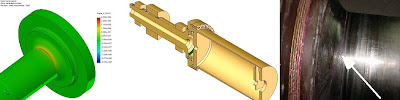
Shaft Failure - Case Study of Warranty Problem
Above is a case study of a shaft failure, done using SolidWorks Simulation, that could have been avoided if a simple life calculation had been performed. Not only is it expensive to replace during warranty period, but time and efforts spent in getting it identified and corrected, leads to unplanned expenditure. Needless to say the company image takes a beating where the damages are incalculable.

Another example of a design gone wrong is shown below.

Case study of a Product Recall
Failure due to improper calculation of loads and stresses lead to a correction on the plastic mould. The product was re-designed for better strength, as shown in the SolidWorks Simulation design above, with a higher factor of safety. The product recall costs are staggering in addition to creation of a huge pile of inventory of parts that cannot be re-used.

Efficiency of a cyclone separator was drastically improved, at the design stage, by performing integrated CFD, as shown below in the FloWorks model. By validating early in the design process, a near-optimal cost effective design was possible for chosen configuration. Particle tracking helped understand bottlenecks such as re-circulation in addition to pressure drop calculations.
Case Study of Optimal Design: Flow Simulation of a Cyclone separator
Innovative Designs can lead to creation of a new market for products that have never been explored. In addition to creating a market share, sans competition, it helps leverage better sales for companies, resulting in increased profits.

Tolerance Analysis can help save money for any manufacturing engineering enterprise by allocating required tolerance to meet design function while minimizing costs.
Tolerance Stack-up Analysis/ Synthesis using SigmundWorks inside SolidWorks

Benefits of Simulation are many-fold. Some of the important ones are:
  • Do it Once – Do it Right
  • Give the Best to the Organization
  • Profit on Day One of Product Launch
  • Valuefacture – Eliminates Competition
  • Save our Planet